The Niche Hypotheses
Through recording of natural soundscapes and then producing a spectrogram for each given recording Dr Bernie Krause has discovered that each and every creature produces sound signatures in their own acoustic niche.
As you can see, in this example kindly given to me by Dr Krause, is that the bats, insects, and birds all vocalise in their own part of the frequency spectrum.
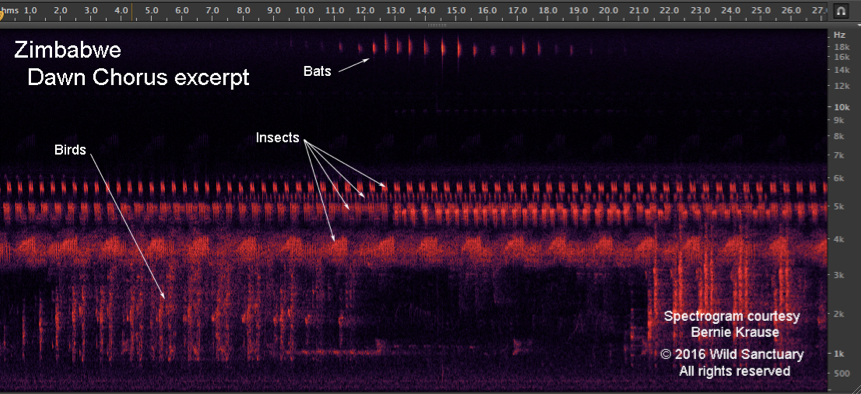
This means that each and every creature can be heard as the sound can propagate without being masked by other geological or biological sounds. This relates directly to how we as human beings structure our own music, think of an orchestra with each sections playing its part, filling it’s own niche. This structure and relationship between natural soundscapes and our music making has direct coloration. In parts of the world were people are more connected to their natural environment we see this relationship intensify and become more evident. More you listen to music and natural soundscapes with that relationship in mind the clearer it becomes. Natural soundscapes appear to be formed with such complexity, and dynamism that if translated into music, be it in our perception and ability to hear these complex relationships or as a source for inspiration, potential for real musical innovation becomes apparent. I know that since listening to and recording the natural wild my own music has shifted, hopefully as part of an developing artistic evolution, and for that I am more aware then ever before of subtle relationships between sounds across time (rhythm), and frequency (pitch). You can read more about the niche hypothesis and the roots of music in the wild in Dr Krause book ‘The great Animal Orchestra’ here, and check out the symphony which is well worth a listen: http://thegreatanimalorchestrasymphony.com/buy/
Fortune, fate, and sound
There are many philosophical ways in approaching music, many of which come from all over the globe be it ‘God’s beat’ and the space in between beats that can be found in Ghana, or the focus on perfecting the single strike of Taiko. The philosophical approach to perceiving sound named ‘Reduced listening’ focuses not on the identification of a sound source, be it biological, mechanical, or anthropological, it is hard to resist that impulse to put a source to the sound. On the other hand ‘Reduced listening’ hones in on the quality of a sound rather then the source. This focus on sonic quality allows for exploration that opens the sonic world up to all manner of sounds. It is with this approach that when sitting with Dr Krause in this studio listening to the call of a hyranx (google it, the cousin of the elephant if you can believe it), the songs of whales, calls of birds, and chorusing frogs. Using some very cool tools such as Adobe Audition we were able to single out different voices from the soundscape. By doing this the individual sonic quality of each sound signature becomes clear, sounds that are so unique that to manufacture similar audio could take hours. There is a rich material ready to be used and worked with from the wild world all around us.
It dawned on me when listening to these sounds that all sound we make on some level is derived from the wild. The discourse I would like to engage with here is that if our sonic world has evolved from the wild world around us then it is possible that all sounds that we may create are preempted by those of the natural wild. For such a possibly controversial statement I point you towards a set of tongue and cheek piece of music by Dr Krause titled ‘Gorillas In the Mix’. Originally intended to for use in schools to demonstrate the very the very notion that humans have their musical roots in the natural world.
Would you believe that all the percussion are fish and the distorted, DISTORTED! electric guitar comes from whale? Although may be a bit outmoded this is a startling example of very recent, and even electrical instrumental sonic qualities.
I don’t think I will be making samba out of fish, or raping gorillas, nevertheless the intrinsic link between our music and the wild is there to be explored, creatively and for kinship with the wild world.
However I leave you to listen to rapping gorillas in the mix.